


Taking Professional Risks
Discover why taking measured professional risks can spark growth, reduce burnout, and inspire both teachers and students—without leaving your comfort zone behind.

Me, Dr. Chris Thuman (our principal) and my co-teacher, Laura Klein
Share
November 18, 2025
Discover why taking measured professional risks can spark growth, reduce burnout, and inspire both teachers and students—without leaving your comfort zone behind.
Share
Do you consider yourself a risk-taker? I do. The thing about risk-taking though is that it is highly personal. For me, it would be a giant risk to perform in our yearly Falcon Teacher Dance during Spirit Week. For many of my teacher besties, it’s a fun way to connect with students, and they have a blast practicing and getting down during the giant assemblies. On the other hand, I love presenting, giving webinars and doing workshops. The more the merrier. I have several friends who think I’m insane to take that risk. To me though, it isn’t a risk. For my dancing queen friends, they just don’t understand that I am uncoordinated and not cool enough to fake it in the back row, and I don’t understand how amazingly talented teachers wouldn’t want to show off what they are so good at.
This blog is not going to persuade you to present at conferences if that terrifies you, nor will I be joining my besties on stage singing R-E-S-P-E-C-T either. Instead, I’m going to challenge you to take a measured risk. Frankly, teaching is hard enough without anyone being traumatized. What do I mean by a “measured risk”? I mean that we all have things we are curious about, but we just don’t have the courage to try because we fear the unknown. For example, it is quite known that I can’t do a choreographed dance, so that isn’t what I mean. Instead, I mean risking being uncomfortable trying something new for the chance to feel alive and exhilarated, no humiliation required.
Last year, I was talked into doing the Buffalo Polar Plunge—a fundraising stunt to raise money for the Special Olympics. The thing to know about Buffalo, N.Y., is that it is always cold in December. The thing to know about last year is that the Lake Erie temperature was 42 degrees, and that was freaking balmy compared with the 24 degrees with 13-mile-an-hour winds outside the water, creating a “real feel” of 17 degrees. In case you were curious: “The National Weather Service advises that wind chill temperatures below 50 degrees F and wind speeds above 3 mph require extra caution to prevent frostbite and hypothermia.”
Why, you might ask, was this particular event a professional risk? For one, I raised $500, mostly from colleagues, who were counting on me to plunge into Lake Erie. Second, my co-teacher and I were suckered (persuaded?) to do this event with our two assistant principals and our principal. And, oh yeah, we were with students. I don’t get nervous about much, but I was stressed the whole week leading up to it. To be honest, and this is going to sound ridiculous, I conceived of this situation as very different from what it actually was. Maybe I’m just a literal English teacher; I somehow envisioned myself jumping into the lake. Could I have watched a video or asked someone how the event worked? Yes, absolutely. I can’t figure out why I didn’t, but knowing myself, I certainly should have. The thing that always paralyzes me is the logistics: What does one wear to such an event? What is the parking like? What happens when you get out of the water? Will I have a heart attack? (Don’t Google that last one.)
As it turns out, you basically run into the water with a bunch of other people. You can go as far as you want, but I made it to the top of my thighs. I saw no reason to have frozen underwear if I could get credit for it anyway. There is no “plunging,” unless you are crazy like Mack Hollins, then a Buffalo Bills wide receiver, known for his eccentric shoeless approach to life, including for this event. Did I hang out with Mack Hollins? There is no way to confirm this either way, so let’s go with yes.
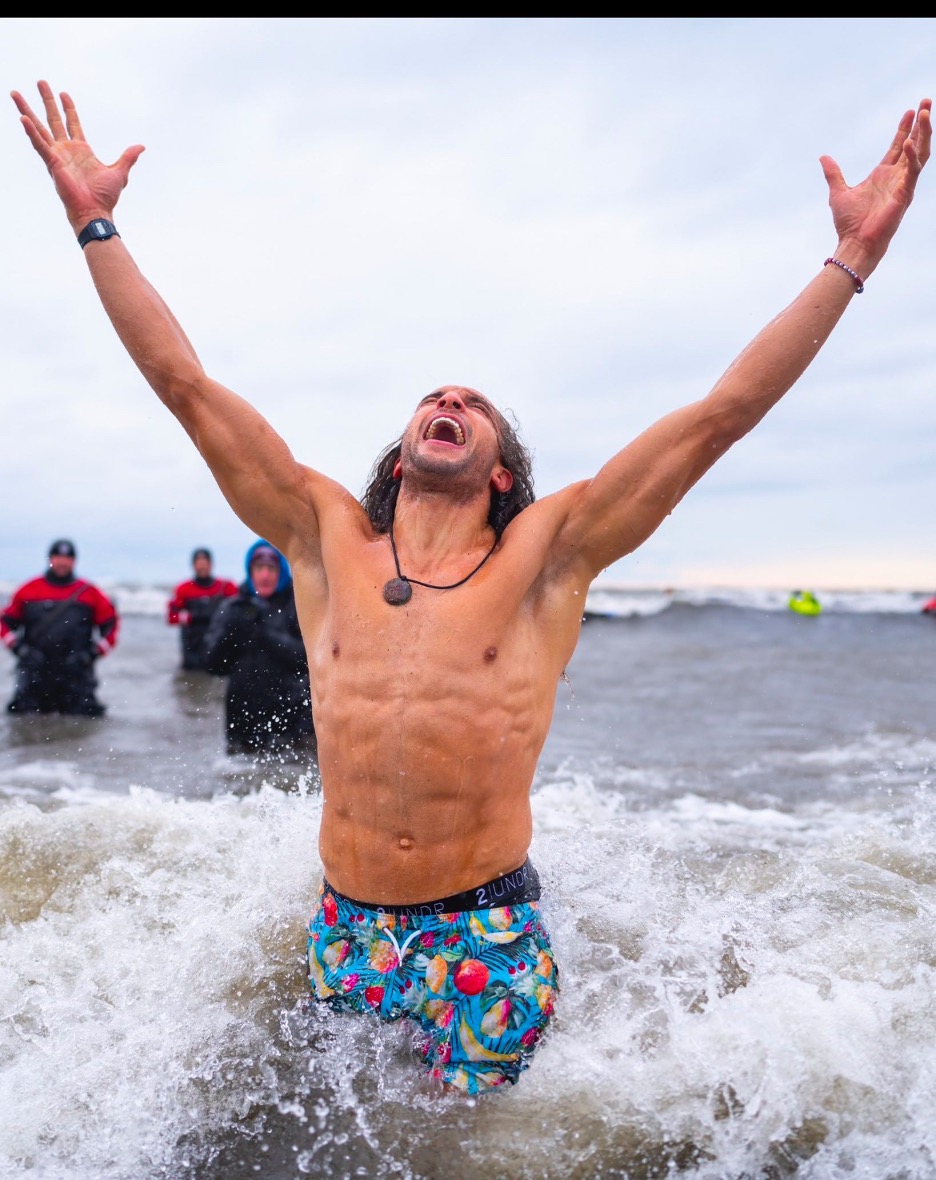
The challenge for you is to zero in on what makes your heart beat faster, what you’d be proud to brag about, and figure out a way to push yourself. In my case, it is almost always my co-teacher bestie, Laura Klein. You can read about the power of co-teaching here. For me, I take myself too seriously, so I needed a push to realize that literally no one cared a bit about my polar plunge, but it would contribute to the $560,000 raised. This was a measured risk in that I did want to “do the thing,” but I was scared of how I’d do at the thing. This fear of being a novice is often in my way, and I bet it is for other teachers as well.
One example I’m seeing right now in my networks is people dabbling with artificial intelligence. Some of us are sticking our toe in, some are more like me at the Polar Plunge and wading in, but there are a few that are jumping in full cannonball! No matter how you feel about AI (and if you are like me, you might not know what to feel), it isn’t going anywhere. A really measured risk that you could take would be to start small like I did. I used ChatGPT to generate rubrics for my college classes. This has always taken a really long time, but I finished in a matter of minutes. It was a small step. If it didn’t work out, it wasn’t consequential. No one was watching, and the stakes were low. I’m still not ready to work with AI in “real time” in my classroom, but the measured risk has helped me build my confidence, at least a little.
I’m still not ready to work with AI in “real time” in my classroom, but the measured risk has helped me build my confidence, at least a little.
Measured risks build upon each other, and Share My Lesson has resources for every level—from those who want to dip their toe into artificial intelligence and even those with the cannonball approach. I’ve found that Share My Lesson's AI in Education Community is the place to start. Their webinars are an example of a measured risk. This webinar on using AI to help English language learners in your classroom, or this one on The AI Educator Brain on Special Education: Unlocking Possibilities with Generative AI allow you to wade in. You watch from home, in your pj’s with your beverage of choice, and you take what you can use and leave the rest. It sounds simple, right? When was the last time you tried something completely new? For most people, it isn’t that often. I love this podcast, with bestselling author and leadership coach Kevin Eikenberry, “7 Reasons We Don’t Start Something New.” Spoiler alert: There’s a pretty good chance you struggle with at least one of these reasons.
Our measured risks can help not only us, but also our students. I love this EdSurge blog, “Why Taking Risks in the Classroom Pays off for Students—and Teachers” because it acknowledges the fear, but it also shares the impact on our students. One way we can provide measured risks for our students is with the tried and true “turn and talk” strategy that allows students to rehearse what they think with another student before they share it with the whole class. This is especially effective in an integrated co-teaching (two teachers—regular education and special education together) “ICT” classroom, and it helps promote inclusion, as addressed in this article from the TIES Center, which promotes inclusive practices.
Maybe you want to coach, or start a poetry club. Maybe you have always wanted to try your hand at building sets for a play. Maybe you want to volunteer for the dunk tank at field day. What has stopped you? If it is a measured risk, then go for it. If you do, you will be there to tell the tale, and be a role model for your students who may not know how to take risks. Last year, the reason I pushed myself to try this new crazy thing was to avoid burnout, which I wrote about here.
Everything I’ve told you in this blog is a part of my “survival story” that I’ll be sharing with my students next week. My co-teacher and assistant principals want to fill a bus with students to take with us, and I personally want to at least match my goal from last year. The thing is, when you do the braver-than-you-are thing, it lights up parts of your brain that desperately need attention. Even better, when we can help kiddos take these positive risks, they can gain new insights. Take a look here at the benefits for our students.
So, do the thing. Not the traumatizing one, but the measured, out-of-your- comfort-zone one. I will be, and this time, so will a busload of students!
Here’s the link to my page: https://events.nyso.org/site/TR/Plunge/POLARPLUNGE?pg=personal&px=1732678&fr_id=3313
Join the team from the AI Educator Brain, which includes AFT’s Share My Lesson director Kelly Booz; New York City Public Schools teacher Sari Beth Rosenberg and EdBrAIn, our AI teammate (yes, it named and designed itself!). In this community, we will dissect the pros and cons of AI tools in education. Our mission: to determine how AI can support teaching and learning, and when it might be best to stick with tried-and-true methods.
Empower your teaching with effective strategies and tools designed to support the whole student. This collection features insightful webinars and blogs covering student well-being, creating positive school environments, and fostering inclusive classrooms.


